
GeoPrior-v3#
Physics-guided AI for geohazards and risk analytics.
GeoPrior-v3 is a scientific Python framework for building physics-guided models for geohazard analysis, forecasting, and risk-oriented interpretation. The current generation focuses on land subsidence through GeoPriorSubsNet v3, while the broader roadmap extends toward landslides and other geohazard modeling tasks. The project combines scientific modeling, configuration-driven workflows, staged CLI execution, and reproducible figure generation in a single documentation space.
Note
GeoPrior-v3 provides both a Python package interface and a
command-line workflow. The project exposes dedicated CLI
entry points for initialization, staged runs, builds, and
plotting, including geoprior, geoprior-run,
geoprior-build, geoprior-plot, and
geoprior-init. See CLI for the full
command reference.
Start here#

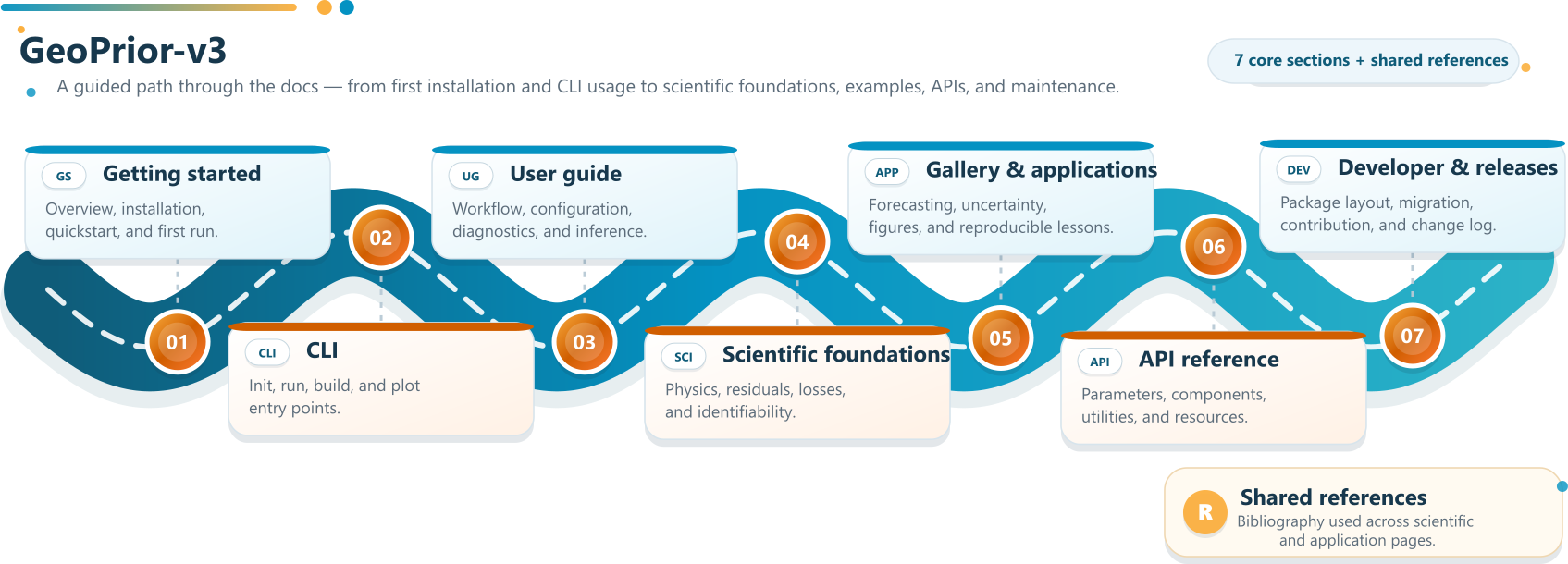
Begin with the project overview, installation guidance, quickstart usage, and a first end-to-end run.

Follow the staged workflow, command-line logic, diagnostics, inference paths, and export-oriented use.

Find run, build, and plot commands, shared conventions, command families, and the main command-line entry points.

Understand the model family, the physical formulation, residual construction, scaling strategy, and the main scientific assumptions.

Browse lesson-style examples for forecasting, uncertainty, diagnostics, applications, figure generation, table builders, and model-inspection utilities.

Browse the documented Python interfaces for parameters, CLI modules, subsidence components, tuners, utilities, and packaged resources.
Roadmap#
Featured applications#
Explore workflow-oriented application pages together with case-study examples that show how GeoPrior is used in practice.

See how the physics-guided pathway changes forecast accuracy, uncertainty quality, and interpretation under a controlled with-physics versus no-physics comparison.

Audit identifiability before reading learned fields literally, using ridge and bounds diagnostics to separate stable structure from non-unique decomposition.

Check how independent borehole and pumping-test evidence anchors the thickness pathway and clarifies what can, and cannot, be claimed from the inferred effective fields.

Turn calibrated forecasts into exceedance maps, ranked hotspot clusters, and persistence-based intervention priorities.

Compare baseline, zero-shot transfer, and warm-start adaptation to see what survives distribution shift and what level of local adaptation is needed before deployment.
Reference and project notes#

Look up core symbols, abbreviations, workflow terms, and recurring scientific language used throughout the documentation.

See package layout, migration notes, and contribution guidance for maintaining and extending GeoPrior-v3.

Track user-visible changes across versions, including workflow, API, scientific, and documentation updates.
Why GeoPrior-v3?#
GeoPrior-v3 is built around physics-aware modeling rather than purely black-box forecasting. The platform emphasizes scientifically interpretable learning for subsidence analysis and broader geohazard settings.
The documentation is organized around how the project is actually used: initialization, staged execution, configuration, diagnostics, inference, plotting, and reproducible scientific outputs.
The project is not only an API library. It is also an application framework with dedicated command-line entry points and figure-generation scripts for research and reporting pipelines.
The current flagship application is land subsidence, but the framework is positioned to expand toward broader geohazard workflows and future physics-guided hazard modeling tasks.
Start in one minute#
Install GeoPrior-v3 once, then choose how you want to start.
pip install geoprior-v3



Learn by examples
Start from gallery lessons for forecasting, uncertainty, diagnostics, and figure generation.
Need project setup first?
Create the working configuration used by staged CLI runs with
geoprior-init.
geoprior-init --help